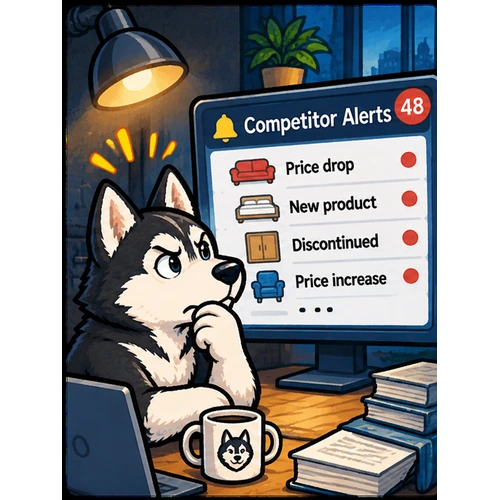
A competitor price change on a best-selling sofa and a newly listed bedside table should not automatically demand the same attention. Yet when every alert arrives in the same queue, teams can spend their morning sorting notifications instead of making decisions.
Competitor alert prioritisation means deciding which observed changes deserve review first, which team owns the review and what evidence is needed before acting. The aim is not to make every alert urgent. It is to make important changes difficult to miss.
Here is a practical way to build that process for a furniture retail team.
Separate detection from decision
A monitoring alert tells you something changed in an observed competitor listing. It does not establish why the change happened or what your business should do.
A lower listed price could be worth investigating, but it does not automatically justify matching. A product disappearing from a competitor's site may be temporary rather than a confirmed discontinuation. A new sofa range may be relevant to your next buying review without requiring an immediate response.
Use two stages:
- Capture: retain the observed change, product, retailer, category and available context.
- Triage: decide relevance, urgency, owner and next review date.
Keeping those stages separate prevents a stream of observations from becoming a stream of unexamined instructions.
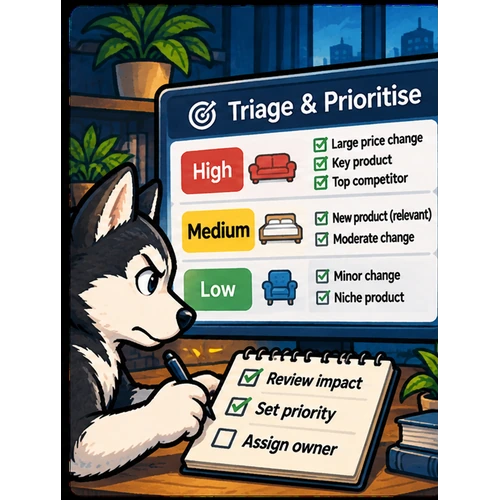
Score the change on four questions
A simple human review works better than a complicated score that nobody maintains.
| Question | High priority looks like | Lower priority looks like |
|---|---|---|
| Relevance | Direct competitor, important category and sufficiently comparable product | Peripheral retailer or unrelated range |
| Commercial exposure | Product or category central to current sales, pricing or planned buying decisions | Small or experimental category |
| Evidence confidence | Clear observed price movement or repeatedly confirmed catalogue change | Ambiguous product identity or a single uncertain removal |
| Decision window | A decision is needed before a live pricing or range review | The next scheduled category meeting is soon enough |
These are review criteria, not an automatic scoring capability attributed to Fido Fetch. Teams can use a simple high/medium/low judgement and document exceptions.
Example: a sofa price decrease
Suppose a close competitor's comparable three-seater sofa is newly listed at £749 rather than £799. That is a £50 observed reduction, not proof of a promotion or a lasting market shift.
If the sofa competes directly with an important range, put it into the next pricing review. Check specifications, delivery terms separately, your own margin and the competitor's price history before considering a response. The guide to deciding when not to react explains why holding your price may be reasonable.
Example: a newly observed dining range
A competitor adds several dining tables in a style your team has been discussing. That may deserve a buyer's review this week, even if no immediate price decision is needed.
First check whether the items are genuinely new observations rather than newly discovered variants. Compare the range with your customer proposition, existing assortment and upcoming buying cycle. Do not treat the number of newly observed listings as evidence of customer demand.
Example: a missing wardrobe listing
A wardrobe disappears from a monitored listing. Record the signal and review its confidence before labelling it discontinued. If the change remains uncertain, keep it in a verification queue rather than telling the buying team that the competitor has abandoned the product.
Use three queues, not one overflowing inbox
For a small team, three queues are often sufficient:
- Review now: relevant, credible changes with a near-term commercial decision window.
- Review at the next category meeting: relevant signals that benefit from context or comparison across several observations.
- Watch or close: uncertain, peripheral or non-actionable changes; retain the reason and revisit if further evidence appears.
“Review now” does not mean “change price now”. It means a named person should assess the evidence promptly.
Agree the criteria with the team before a busy period. Otherwise the loudest alert or most senior recipient tends to set the agenda.
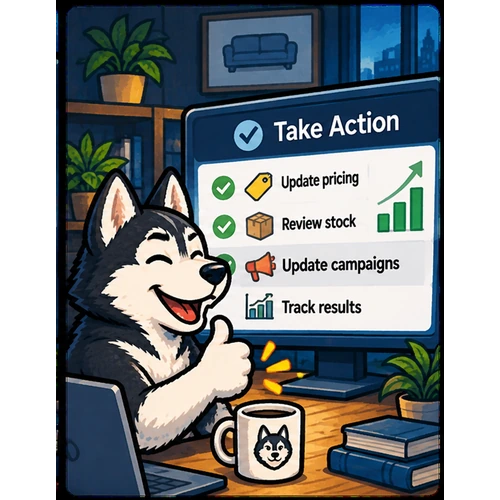
Give each alert one owner and one next action
An alert copied to five people can still go unanswered. Assign a primary owner by decision type:
| Observed change | Likely first reviewer | Useful next action |
|---|---|---|
| Comparable competitor price movement | Pricing or ecommerce manager | Check comparability, history and margin |
| Newly observed product or range | Buyer or merchandiser | Compare assortment fit and buying calendar |
| Product removed or missing | Category manager | Verify the signal before changing plans |
| Repeated changes across a key category | Ecommerce or commercial lead | Add the pattern to the next category review |
The person receiving an alert need not be the person who makes the final commercial decision. Make the hand-off explicit.
A useful review record can be just five fields: observation, priority, owner, next action and review date. Add the final decision when the review closes.
Set an escalation rule that fits your business
Escalate when a change affects a commercially important category and the normal review cycle would be too slow. For example, a verified price movement on a directly comparable flagship sofa might warrant a same-day check, while several new occasional tables can wait for a weekly buying meeting.
Avoid blanket rules such as “every reduction over 10% is urgent”. A large percentage change on an irrelevant item may matter less than a smaller move on a core product.
Review the rule after a few cycles. If most alerts are labelled urgent, the threshold is not distinguishing important work.
Measure whether triage is helping
Count decisions and useful reviews, not merely notifications sent.
Consider tracking:
- the proportion of alerts that reached the right owner;
- time from relevant alert to first human review;
- how many high-priority reviews led to a documented decision, including a decision to wait;
- how many alerts were closed as irrelevant, uncertain or non-comparable;
- whether any important changes were missed because ownership was unclear.
The competitor monitoring KPI guide offers a wider framework for assessing monitoring usefulness. These measures describe your team's process; they do not establish that an alert caused additional revenue.
A weekly routine for furniture ecommerce teams
At the start of the week, clear the review-now queue and confirm owners. During the week, route relevant price, new-product and removal signals to the appropriate category reviewers. At the next regular meeting, look for repeated patterns rather than debating every isolated change. Close each reviewed item with a reason and next step.
If an alert keeps recurring without informing a decision, reconsider its priority or the scope being monitored. If an unexpected change repeatedly proves useful, adjust the criteria so similar evidence reaches the right person sooner.
Fido Fetch can help teams notice competitor price changes, new products and removed listings through monitoring and notifications. The priority, interpretation and commercial response remain decisions for your team. That division of labour is what makes an alert process manageable.
The takeaway
Effective competitor alert triage is not about reacting faster to everything. It is about making the right evidence visible to the right person at the right time.
Start with relevance, commercial exposure, confidence and decision window. Route each signal into a clear queue, name an owner and record the decision. Your team can then spend less time debating notifications and more time reviewing the competitor changes that actually matter.