

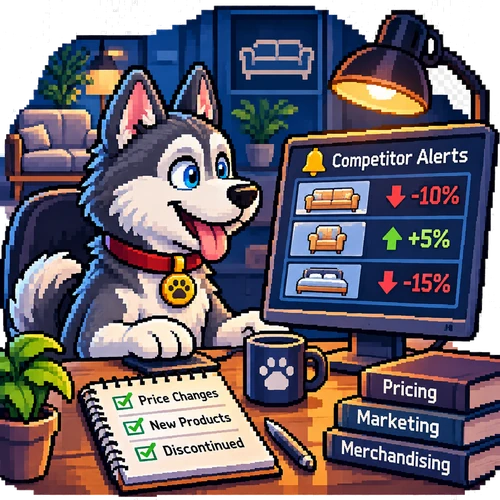
Black Friday can put furniture ecommerce teams under pressure to react to every rival discount. But the loudest sale banner does not necessarily represent the strongest competing offer — and a rushed price match can sacrifice margin without improving conversion.
The useful question is not simply “Who is cheapest today?” It is “What has actually changed, which offers are genuinely comparable, and what decision does that justify?”
This checklist gives furniture retailers a practical way to monitor competitor pricing, new products and disappearing listings before, during and after Black Friday.
1. Establish your baseline before the promotions begin
A Black Friday price only tells part of the story. To understand a claimed discount, you need an earlier observed price and the dates on which it appeared.
Start with a focused set of competitors and commercially important furniture products. For each item, record:
- Retailer, product name and source URL.
- Current observed price and the date it was checked.
- Earlier observed prices, where available.
- Relevant size, material, fabric and configuration.
- Whether the listing is a single item or a bundle.
- Your closest equivalent product and its margin constraints.
For example, a sofa advertised at £699 with a “was £899” label may look compelling. But if your monitoring history shows that it was listed at £729 for much of the preceding month, the advertised saving should not be treated as the full measure of its competitive impact.
Historical observations are evidence of what was listed at particular times, not a guarantee that you have captured every intervening price. Read more in Temporary Promotion or Permanent Price Change?.
2. Compare the actual furniture offer, not just the discount percentage
Furniture is difficult to compare on headline price alone. Two similarly photographed sofas may differ in size, upholstery, seat configuration, frame construction or what is included.
Before flagging a rival offer as a direct pricing threat, ask:
- Are the products the same or sufficiently similar for the intended comparison?
- Does the offer apply to the same size, fabric or finish?
- Is the price for one item, a set or a bundle?
- Are delivery, assembly and returns terms materially different?
- Is the advertised item actually available to order?
Do not claim your offer is cheaper on a total-cost basis without separately verifying the relevant delivery and other charges. Fido Fetch! focuses on monitoring competitor product listings, prices, new items and removals; additional checkout charges may require manual verification.
The guide to comparing similar furniture products explains how to avoid misleading like-for-like comparisons.
3. Build a Black Friday watchlist around commercial exposure
Monitoring every product with equal attention is rarely practical. Prioritise the categories and products where a competitor change could affect a live decision.
A useful watchlist might contain:
| Watchlist group | Example | Why review it |
|---|---|---|
| Direct comparisons | Similar three-seater sofas | Customers can compare offers closely |
| High-exposure products | Your best-selling bed frames | Pricing decisions may affect meaningful revenue |
| Promotional products | Dining sets in your planned campaign | A rival move may change campaign positioning |
| Range changes | Newly listed or removed wardrobes | May affect merchandising or buying decisions |
Keep a separate lower-priority list for distant competitors and products that are not currently relevant. A focused watchlist is easier to review consistently than an overflowing alert feed.
4. Give price changes a review process, not an automatic reaction
When a competitor reduces a price, use a short decision sequence:
Verify the change. Check the product identity, observed old and new prices and whether the offer is still visible.
Assess the exposure. Is it a close competitor on an important product, or an isolated offer with limited relevance?
Check your own economics. Review margin, stock, marketing commitments and the value of your service proposition.
Choose a response. Hold price, adjust selectively, strengthen value messaging or schedule another review.
Consider a hypothetical example: a rival reduces a comparable dining set from £999 to £899. Matching immediately would mean giving up £100 of selling price per unit before considering any cost changes. That may be justified in some circumstances, but it is a commercial decision — not a consequence of the alert itself.
For a fuller decision framework, see When NOT to React to Competitor Price Changes.
5. Watch new listings and disappearing products too
Black Friday monitoring should not stop at price drops.
New products: A newly observed listing may be a genuine range addition, a newly discovered product or a variant that was not previously captured. Check the context before interpreting it as a deliberate launch.
Missing products: A listing that disappears might be removed, moved, temporarily unavailable or missed during a scan. Avoid describing a single missing observation as confirmed discontinuation.
Price increases: Some competitors may increase prices on products outside their headline promotion. Record the change, then assess it independently rather than assuming every increase is an opportunity to raise your own prices.
Fido Fetch! is designed to help furniture teams track these three core signals: price changes, new product listings and removed products. The monitoring evidence supports better investigation; it does not reveal a competitor's motives.
6. Agree who reviews which alerts
Black Friday is a poor time to decide who owns a pricing decision. Agree responsibilities beforehand.
| Signal | Suggested owner | First action |
|---|---|---|
| Significant comparable price reduction | Pricing or ecommerce manager | Verify and review margin |
| New range in a strategic category | Buyer or merchandiser | Compare with current assortment |
| Uncertain product removal | Ecommerce analyst | Recheck before escalation |
| Relevant competitor promotion | Marketing manager | Review campaign positioning |
Use a short daily review for urgent items and defer lower-impact changes to the next scheduled meeting. The exact cadence should reflect your team and trading exposure, not a universal rule.
For a reusable framework, see How to Triage Competitor Alerts.
7. Measure the result after Black Friday
Once the promotional period ends, look beyond the number of alerts received.
Review which competitor changes prompted action, which were ignored correctly and whether decisions were supported by adequate evidence. Compare your own conversion, revenue and margin outcomes where reliable data exists. A competitor alert alone cannot prove that it caused a commercial result.
Ask your team:
- Which price changes genuinely threatened important products?
- Where did we avoid unnecessary discounts?
- Did any new or missing listings influence merchandising decisions?
- Were the alert owners and review windows practical?
- What should change before the next major promotion?
Keep the useful findings in your next campaign plan. The aim is a repeatable monitoring process, not a frantic annual exercise.
Your Black Friday monitoring checklist
- [ ] Select your highest-priority competitors and comparable products.
- [ ] Record dated baseline prices before promotional changes.
- [ ] Check variants, bundles and total-offer differences separately.
- [ ] Agree review owners and margin guardrails.
- [ ] Monitor price increases, decreases, new listings and removals.
- [ ] Verify ambiguous changes before escalating them.
- [ ] Document each action — including the decision to hold price.
- [ ] Review results and improve the process after the event.
Stay informed without checking every competitor manually
Black Friday is a reminder that the most valuable competitive intelligence is not the biggest pile of price data — it is a clear record of changes that helps your team make better decisions.
Fido Fetch! monitors competitor furniture product listings and prices, helping retailers spot price movements, new items and removed listings. Set up the competitors you care about, choose your notification preferences and use those updates to guide a more deliberate promotional strategy.